Author: Anja Fabricius Madsen

srcset="/wp-content/uploads/yootheme/cache/70/Topbanner_FallBack_Desktop_1080x600_2-70670d6c.jpg

Port of Partnerships

With the new strategy Port of partnerships for a green world , the port is building on a period of great development and progress, as evidenced by the earnings records of the last two years.
This includes the introduction of a new green core segment, Energy & Innovation, and channelling procurement in a more sustainable direction.

"In our previous strategy period, we set a strong direction for the port's future by focusing on development within seven selected core segments. Today, our vision is still to create growth for businesses and society. But today, green transition is on the agenda, the world is changing and the Port of Grenaa is part of it", says Henrik Carstensen, CEO, Port of Grenaa and continues:

"As one of Denmark's major commercial and industrial ports, we believe it is our duty to contribute to achieving the Danish and European goal of full climate neutrality by 2050. Therefore, with the new strategy, we will sharpen the focus on supporting green growth. This means that we must dare to think innovatively, that we must work smarter and that we must contribute to the development of new green technologies.

Sustainability externally and internally

Port of Grenaa has allocated sustainability efforts to seven of the UN's Sustainable Development Goals, in the areas of business sustainability and organisational sustainability.

Business sustainability relates to the port's commercial approach to the market, offering port customers sustainable solutions that strengthen their core business.

Organisational sustainability addresses the internal lines where the port as an organisation will be greener, while focusing on social responsibility and competence development of employees.

"The strategy contains a number of concrete objectives that we are ready to put into action now.One of the key initiatives is that at least 10% of the Port of Grenaa's annual profits are used to invest in green solutions, such as access to green power throughout the port and investment in sustainable equipment."

Want to change and improve with energy & innovation

With the new Energy & Innovation core segment, the port's ambition is to future-proof the industry by establishing intelligent solutions to make logistics run more smoothly and energy resources last longer.

"We believe that a port that seizes new technological opportunities becomes a better port for its partners. For example, we have just invested DKK 25 million in an intelligent Liebherr crane. In addition to being equipped with intelligent automated technology, the crane is currently in Rostock to be converted to run on electricity," says Henrik Carstensen.

Test platform for future green energy

With Energy & Innovation, the port aims to join forces with several globally oriented partners on environment, recycling, but also to become a large-scale test platform for new forms of energy, so-called Power-to-X:

"Port of Grenaa is already known as one of Denmark's leading ports for wind turbine projects. At the same time, we have always worked to promote and develop the transport chain. We will make our experience in these two areas available for the development of new green energy, which will be crucial for the transformation of the entire transport industry", notes Henrik Carstensen.

Just before the turn of the year, the board of Port of Grenaa decided to invest up to DKK 100 million in a historic port expansion, which is expected to be completed in January 2023. The port area will be flexibly designed and upgraded to 18 MW shore power, making it available for large projects across the port's core segments, such as a pre-assembly area and base and service center for Hesselø Offshore Wind Farm and Power-to-X testing.

srcset="/wp-content/uploads/yootheme/cache/ea/Nyheder_Infrastrukturforbedringer_pa%CC%8A_dagsordenen_2-ea8924fd.jpg

Infrastructure improvements on the agenda

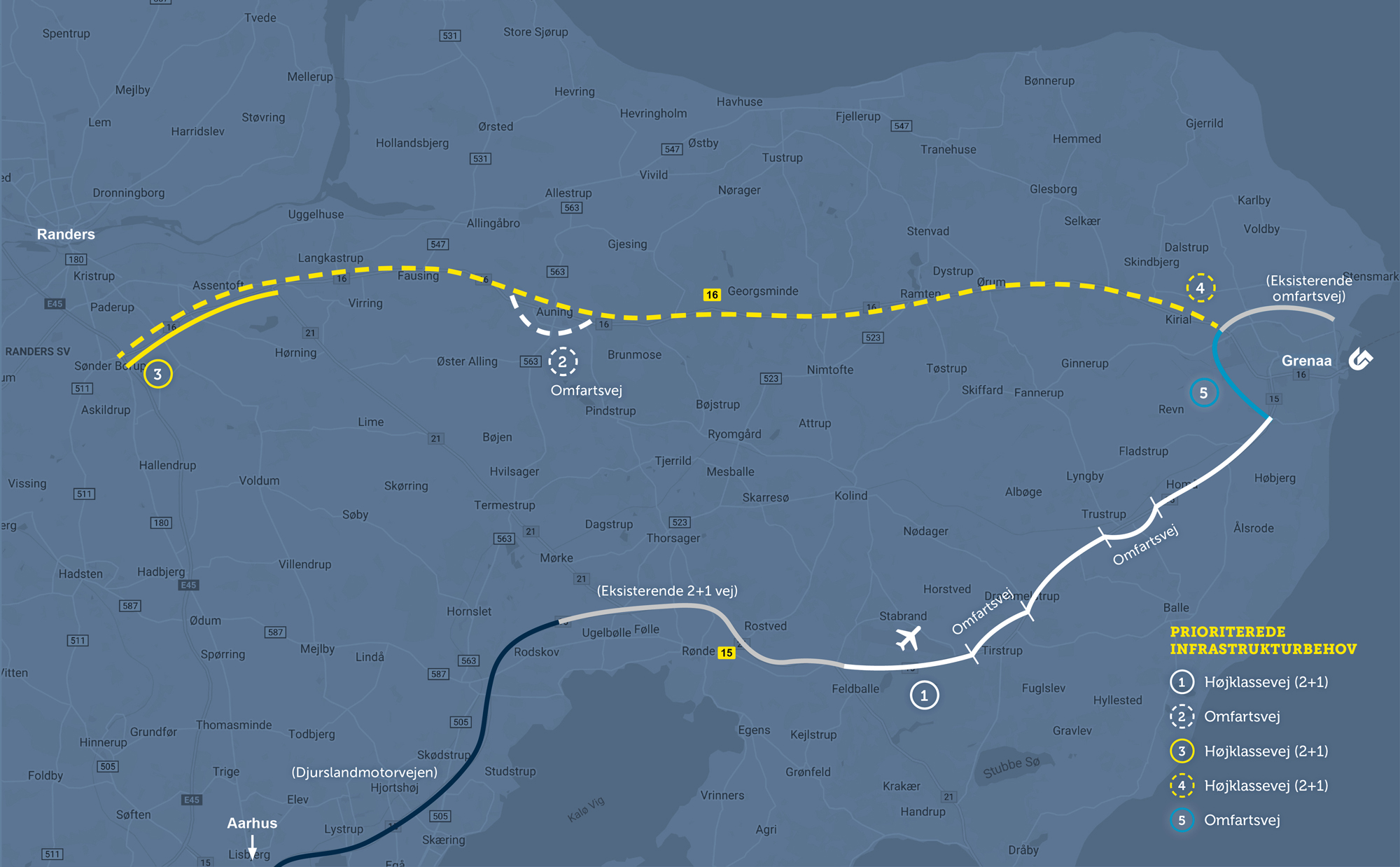
The Grenaa-Halmstad ferry link will relieve pressure on the road network by acting as a floating highway for many of the thousands of lorries that travel between Jutland and southern Sweden every year. This places high demands on the infrastructure in Djursland. In addition, Port of Grenaa will prepare itself and the infrastructure for a massive increase in activity for a future offshore wind farm or more in the Kattegat. For example, Hesselø in Kattegat, which is expected to be completed in 2027.

At Port of Grenaa , CEO Henrik Carstensen has already presented several politicians with the Port of Grenaa's prioritized infrastructure needs, as the Port of Grenaa has a dedication to live up to the government's wishes to move traffic from road to sea.

The problems of congestion on the roads must be solved, and one of the ways to do this is to use our ports and sea routes, says Henrik Carstensen.

The port is stepping up dialogue with more politicians who can support the port and local area's efforts to continuously modernise infrastructure.

The illustration above shows Grenaa Port's prioritised infrastructure needs, where the first priority is a so-called 2+1 high class road from the end of the Djursland motorway to Grenaa.

srcset="/wp-content/uploads/yootheme/cache/4a/Nyhed_liebherr.-4a716312.jpg

Intelligent hybrid harbour crane

The Liebherr hybrid mobile harbour crane is expected to be delivered in March 2021. Until then, it will be updated at Liebherr in Rostock, where it will be converted to run on electricity.

"Cranes and other large machines that handle equipment at Danish ports require large amounts of diesel and emit CO2 when unloading and loading. Therefore, we see the transition to electric machines as an important step towards a greener transition," says Henrik Carstensen, CEO at Port of Grenaa, and continues:

The purchase of the Liebherr mobile crane supports the UN's Sustainable Energy Goal 7, which is one of the goals we are working on in our new 2025 strategy. By converting the crane to run on electricity, we can eventually reduce the climate impact of handling goods at berth."

Intelligent technology makes material handling more efficient

The crane is equipped with intelligent features such as ergonomic control and advanced software that both help crane operators and guarantee increased productivity:

"With the advanced software, including the teach-in function, material handling is automated so the operator does not have to unload and load manually. This means that the crane can run several cycles per hour, which makes operations much more efficient," says Henrik Carstensen.

The 467-tonne crane has a lifting capacity of 144 tonnes at 20 metres and 40 tonnes at 54 metres, and 360-degree mobility. This ensures high manoeuvrability, making it suitable for large-scale operations such as handling bulk, scrap and project cargoes on the ever larger ships calling at the quay or as STS (ship-to-ship) operations.

An ideal partner for large-scale projects

"With our quaint harbour and central location, Port of Grenaa is an ideal hub port with optimal conditions for efficient distribution throughout the country. Couple this with our secure storage facilities and efficient equipment such as the newly acquired Liebherr crane, and we are living up to our goal of being able to provide high-quality, customised services for even the most extensive projects," says Henrik Carstensen.